
Background Information
Save the Children International (SCI) is a non-governmental organization whose mission is to inspire breakthroughs in the way the world treats children and to achieve immediate and lasting change in children’s lives worldwide. SCI has been operational in Somalia since 1951. Guided by the Country Strategic Plan (CSP) for 2022-2024, SCI strives to ensure the most deprived children aged 0-5 years have a strong start in life; children aged 6–14 years have a better foundation for a bright future; young people aged 15-24 years become socially and economically productive citizens; girls and women have greater voice, choice and control over decisions affecting their lives, and strengthened government and civil society capacity to sustain child wellbeing in Somalia/Somaliland. SCI Somalia/Somaliland implements a range of child-focused and thematically integrated programs across Somaliland, Puntland and Southern States through sustainable humanitarian and/or development programming which enhances both government and community ownership.
Strengthening the organizational capacities and coordination of local actors is essential for fostering local resilience and ensuring that humanitarian interventions are both sustainable and accountable to affected populations. Local actors are uniquely positioned to understand the needs of their communities, allowing them to tailor interventions that are most relevant and appropriate. Long standing relationships with communities, rapport with target populations resulting from an extensive period of service, and unique contextual understanding are key reasons why local actors are well placed to design and deliver interventions. Empowering local and national NGOs to participate in decision-making processes can lead to increased ownership, resulting in more timely, effective, and responsive outcomes for the most deprived and vulnerable children, as well as their communities, while promoting the fulfillment of children's rights.
This project aligns with and contributes to the localization goals set forth in Save the Children Somalia’s current CSPs for 2022-2024 and upcoming 2025-2027. Both plans emphasize building equitable partnerships and advancing institutional development among local and national partners. Specific targets include increasing the number of projects co-designed or led by local actors, boosting direct support through tailored capacity-building, and ensuring that 50% of funding is directed to national CSOs and government institutions, including overhead and administrative costs. The Somalia Country Office Localization Strategy for 2022-2024, as well as the upcoming 2025-2027 strategy, outlines clear steps to achieve these localization commitments.
A key element of this project is engaging the Somali Child Rights Coalition (SCRC) as an implementing partner. The SCRC plays a vital role in strengthening the capacity of local partners, facilitating coordination, promoting leadership, increasing funding access, and driving policy advocacy. This multi-sectoral coalition of civil society organizations (CSOs) is dedicated to protecting and advancing children’s rights across Somalia, with broad membership from both local and national organizations. The SCRC focuses on raising awareness, influencing policy, and strengthening child protection mechanisms, aiming to keep children’s welfare at the forefront of the Somali government’s agenda and aligned with international child rights treaties. As an independent coalition, the SCRC serves as a united voice for Somali children, advocating for systemic change and policy development at national, regional, and international levels.
The project will engage 15 CSOs, including women-led, youth-focused, and DPOs, to strengthen local ownership and drive capacity-sharing efforts. Five new partners will be added in this phase, building on previous progress. These organizations will undergo an Organizational Capacity Assessment (OCA) and receive tailored support to strengthen their institutional and technical capacities in areas such as coordination, advocacy, safeguarding, fundraising, program planning, mutual accountability, risk management, gender equity and social inclusion, negotiation, and leadership pathways.
The project will work with the Office of the Prime Minister (OPM) at an institutional level to strengthen local partners' and OPDs' roles in national coordination and advocacy frameworks. This includes peer-to-peer learning sessions to enhance local leadership in OPM-coordinated activities, as well as high-level advocacy meetings to promote active participation from women, youth, child-focused CSOs, and OPDs. Through this institutional collaboration with the OPM, the project aims to create a more inclusive child protection system by integrating local voices and leadership into national frameworks and decision-making processes.
A key component of the project is to increase access to funding for locally-led initiatives, thereby enhancing the resource mobilization capacities of local partners. Local and national CSOs will be encouraged to take on leadership roles within the child protection cluster, child rights coalition, and Areas of Responsibility (AoR), thereby increasing their influence in national decision-making processes. To support learning and evidence generation, the project will conduct several studies, including assessments of the impact of locally-led initiatives and a framework for measuring the effectiveness of capacity-building efforts. Additionally, the project will address challenges and identify strategies for fostering equitable partnerships, with a focus on direct funding for national CSOs, meaningful participation, and strengthening child protection systems throughout Somalia.
Ultimately, this initiative aims to create a more inclusive and effective child protection system that empowers local actors and directly addresses the needs of vulnerable children and their communities.
• Overall Objective/Impact level
To empower local and national actors by strengthening their institutional capacities, enhancing their leadership roles in CP coordination mechanisms, and increasing their access to funding
• Specific Objective(s)/Outcome level (Keep the number limited to a maximum of three)
Outcome 1: Strengthen capacity for local civil society organizations to access and implement locally led projects on child rights, Child protection and localization.
Outcome 2: Influential L/NA play a leadership in CP coordination mechanisms and Child Rights Coalition.
Outcome 3: Strengthened and sustainable institutional capacities for local/ national actors from Somali Child Rights Coalition, CP and LWG that takes collective action on child rights and child protections
Save the Children aims to conduct an external baseline-line evaluation for the project titled "Som Localization Practice in Somalia phase II." To assess the current status of the outcome indicators, set realistic targets and gain contextual understanding that can support achieving the project objectives/outcomes.
2.0 General Objective of The Evaluation
The overall objective of the assignment is to assess the status outcome indicators before the intervention and acquire the baseline values that will be instrumental for setting realistic targets for all outcome indicators. The baseline will also provide contextual understanding of the CSOs and provide actionable recommendations to amplify the project impact.
2.1. Specific Objectives
✓ Evaluate CSO capacity to advocate for child protection & child rights governance.
✓ Assess capacity for local civil society organizations to access and implement locally led projects on child rights, Child protection and localization.
✓ assess sustainable institutional capacities for local/ national actors from Somali Child Rights Coalition, CP and LWG that takes collective action on child rights and child protections.
✓ Influential L/NA play a leadership in CP coordination mechanisms and Child Rights Coalition.
✓ Assess the capacity of local CSOs for fundraising and resource mobilization.
✓ Assess how CSOs enhance coordination among themselves to strengthen CP systems.
✓ Assess how CSOs leveraged locally led projects in partnership with SCI and other INGOs.
✓ Provide practical, contextualized recommendations for strengthening child protection systems and localization in Somalia
Methodology
The baseline study of the existing child protection systems and localization initiatives will be conducted with a qualitative data collection method, ensuring a comprehensive understanding of the project's impact and sustainability. The evaluation will commence with an exhaustive review of all pertinent project documentation, including the project proposal, partners strategic documents SCI country strategy among others.
In addition to document analysis, the consultant will engage in qualitative data collection through focus group discussions and key informant interviews with project key stakeholders including CSO/local partners’ staff, SCI and government staff. These discussions will be designed to capture a range of perspectives from various stakeholders involved in the child protection system. A participatory approach will be central to the evaluation, ensuring that the process is informative.
The consultant will work in close collaboration with the Save the Children technical team, adhering to their guidance and direction throughout the evaluation process.
To ensure the validity and reliability of the findings, the consultant will propose and agree with Save the Children on a robust sampling methodology. This methodology will be designed to allow for accurate conclusions about the study population. The consultant will employ mixed methods of information gathering, which may include, but are not limited to, key informant interviews, focus group discussions, observation methods, and other suitable approaches for the study. The chosen methods will be detailed in the methodology section of the inception report, outlining how each approach will contribute to achieving the desired results.
The evaluation process will be inherently participatory, actively involving government representatives, partner organizations, and their protection networks. This involvement will ensure that the study benefits from a wide range of insights and experiences, thereby enriching the evaluation and its subsequent contributions to the field of child protection and localization efforts.
3. Consultant Role and Expecting Deliverables
The consultant is expected to perform through 3 phases –inception, data collection process, reporting and dissemination, training data collectors, document review, data collection, analysis/interpretation, report writing, and presentation to key stakeholders
The evaluation will have the following key phases:
Phase I - Desk study: Review of documentation and elaboration of field Study
The lead consultant/evaluation team will review relevant documents (Reference material). Based on this review, they will produce an inception report which will include an elaborate plan of the evaluation that will include but not limited to study, methodology including (KII & FGD guides), and sampling strategy of the data collection plans etc. The evaluation will only proceed to the next stage upon approval of the inception report. An appropriate inception report format will be provided to the selected consultant.
Reference Materials
• Project narrative proposal and the logical framework
• Project monitoring and evaluation plan
• Monthly and Quarterly Reports
• Project MEAL reports
• Case management reports
• Training reports
• Project narrative reports
Phase II: Field Data Collection
This phase of the evaluation will seek to collect primary data on the key evaluation questions explained under the evaluation criteria. The consultant will use the agreed plan, methodology, tools, and sampling strategies from phase 1 to conduct the fieldwork.
Phase III – Data analysis and production of evaluation report
As a minimum, the evaluation process will include the following key steps:
• Review of relevant literature related to the project (list of reference materials provided below) and draft an inception report before the evaluation exercise in the field.
• Application of appropriate data collection tools for interviews and focus group discussions;
• Data analysis and Evaluation Report writing, and
• Presentation of key evaluation findings.
• to share transcripts, photos, GPS, and case studies.
4. Reporting
The consultant will maintain daily contact with the SCI team assigned to manage the evaluation activities. The data collected will be analyzed on a daily basis by the consultant and given feedback to the collection teams.
A final report with main text of maximum 40 pages excluding the cover page, table of contents, abbreviations, and annexes. The draft report should be delivered in a soft copy in English. References should be fully cited after all important facts and figures. The report should be structured as follows:
• Front page with the title of the report, project and SC CO name, date, and authors of the report
• Table of contents
• List of abbreviations used.
• Executive summary (3-4 pages) that presents the key points of the different sections.
• Brief background and description of project
• Objectives and the intended use of the evaluation
• Methodology and limitations of the evaluation
• Challenges, lessons learnt and suggested actions for the way forward with timelines and responsibility.
• Annexes
• Tools used.
• Evaluation schedule
• List of people interviewed or consulted
• Bibliography of the documents reviewed
• Terms of Reference for the evaluation
• Summary table of indicators baseline vs progress of its achievements
4.1. Time Frame
The consultancy work will last approximately 40 days including induction and travel days. The days will start by the date the contract is signed.
4.2. Terms and Conditions
Consultancy fee: The consultant will come up with his/her own rate which will be subjected to negotiation within the bounds of donor requirements and set standards of SC in Somalia the consultant is expected to estimate all relevant costs for the exercise, including costs for data collectors, vehicle rent, venue, stationary, standardization test and accommodation while undertaking activities related to this assignment.
4.3. Code of Conduct
Save the Children's work is based on deeply held values and principles of child safeguarding, and it is essential that our commitment to children's rights and humanitarian principles is supported and demonstrated by all members of staff and other people working for and with Save the Children. Save the Children's Code of Conduct sets out the standards to which all staff members must adhere, and the consultant is bound to sign and abide by the Save the Children’s Code of Conduct.
A contract will be signed by the consultant before the commencement of the action. The contract will detail terms and conditions of service, aspects of inputs, and deliverables. The Consultant will be expected to treat as private and confidential any information disclosed to her/him or with which she/he may come into contact during her/his service. The Consultant will not, therefore, disclose the same or any particulars thereof to any third party or publish it in any paper without the prior written consent of Save the Children. Any sensitive information (particularly concerning individual children) should be treated as confidential.
An agreement with a consultant will be rendered void if Save the Children discovers any corrupt activities have taken place either during the sourcing, preparation, and implementation of the consultancy agreement.
4.4. Ethics and Child Safeguarding
The consultant is obliged to conduct the research in an ethical manner making sure children are safe at all times. The consultant should seek the views of various stakeholders, including children. Efforts should be made to make the research process child-centered and sensitive to gender and inclusion. The consultant must respect the rights and dignity of participants as well as comply with relevant ethical standards and SC’s Child Safeguarding Policy and Code of Conduct. The research must ensure voluntary, safe, and non-discriminatory participation and a process of free and un-coerced consent. Informed consent of each person (including children) participating in data collection should be documented.
A contract will be signed by the consultant before the commencement of the action. The contract will detail terms and conditions of service, aspects of inputs, and deliverables.
Property right:
All data that will be collected should be considered as SCI properties and can’t be used for other purposes.
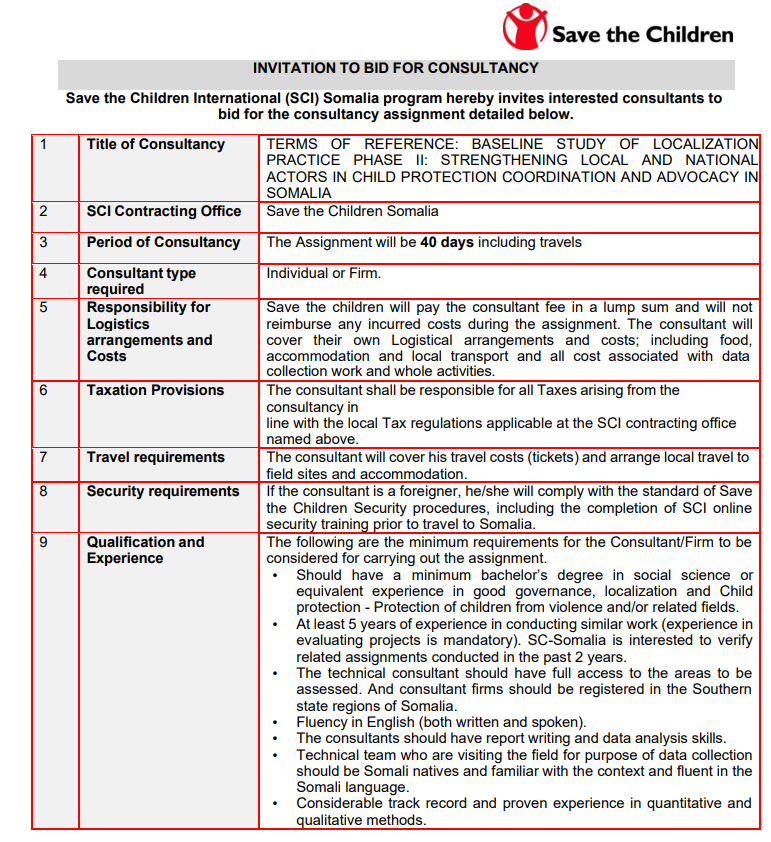
4.5. Application Procedure and Requirement
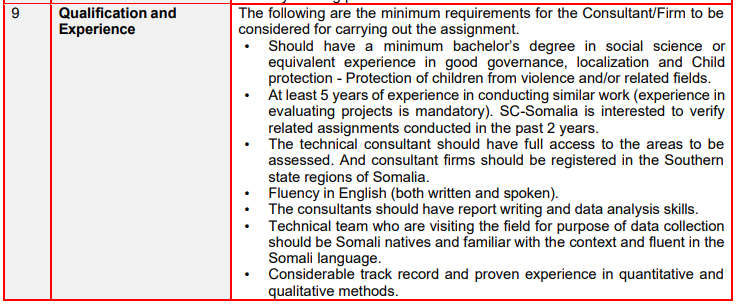
Candidates interested in the position are expected to provide the following documentation:
• A technical proposal with a detailed response to the TOR, with a specific focus on the scope of work, methodology, and timelines, and how the participation of children and persons and children with disabilities in the evaluation will be ensured.
• Initial work plan and an indication of availability.
• A financial proposal detailing the daily rate expected including accommodation, transportation, stationery, data collectors, research assistance, and all other cost related to this assignment. (Operational and consultancy fees).
• Company profile or CV including a minimum of 3 references.
• At least two previously conducted similar studies.
4.6. Contract Management and reporting arrangements
SCI will contract a potential consultant or Firm with special needs background to conduct the End line Evaluation of BASELINE STUDY OF LOCALIZATION PRACTICE PHASE II

Interested consultant (s) who meet the consultancy requirements are requested to submit their bid and each application package should include the above required minimum requirements.
Applications can be submitted by either:
Electronic Submission via ProSave (Recommended)
➢ Submit your response in accordance with the guidance provided in the below document:
• Bidders are encouraged to apply via Ariba system. Please request the Ariba link via email sending your company profile and Business registration certificate/CV. Please address your Ariba link request to css.logistics@savethechildren.org
Electronic Submission via Protected Email box (Optional)
• Email should be addressed to southcentral.supplychain@savethechildren.org
• Note – this is a sealed tender box which will not be opened until the tender has closed.
Therefore, do not send tender related questions to this email address as they will not be answered.
The subject of the email should be Baseline Study of Localization Practice Phase II:
Strengthening Local and National Actors In Child Protection Coordination and Advocacy In Somalia
• All attached documents should be clearly labelled so it is clear to understand what each file relates to.
• Emails should not exceed 15mb – if the file sizes are large, please split the submission into two emails.
• Do not copy other SCI email addresses into the email when you submit it as this will invalidate your bid.
Applicants should also indicate the date they are available to start working on the consultancy
All applications MUST be submitted on or before the closing date below to be considered for the assignment.
Only shortlisted Candidates will be contacted.
Closing date for
• Your bid must be received, no later than 19th April 2025
Applications
• Application Submission address: indicating “” as the subject.
• Bids must remain valid and open for consideration for a period of no less than 3 weeks
WE BELIEVE EVERY CHILD DESERVES A FUTURE. Around the world, too many children start life at a disadvantage simply because of who they are and where they come from. Millions of children are dying from preventable causes, face poverty, violence, di... Read More
