BACKGROUND
Save the Children (SC) has been operating in Somalia for more than 70 years and is widely recognized as a national leader in humanitarian and development programming in various sectors including Health, Nutrition, WASH, Food Security and Livelihoods, Education, and Child protection. We have a strong presence in the Health and Nutrition sectors, supporting a significant number of health, nutrition and WASH facilities, mobile health units, and Integrated Community Case Management sites across the country, including the Hiiran region where we have 17 sites . We (SC) operate in 17 out of the 18 regions of Somalia/Somaliland, with 14 field offices and a team of over 600 dedicated staff. Our extensive operational presence enables us to promptly initiate and sustain project activities. In Hiiran, we have established a field office in Beledweyne since 1992, with a team of 46 staff led by the Field Manager, supported by additional staff in Bulaburte and Mataba districts. Throughout the years, SC has been at the forefront of responding to various crises in Somalia, including droughts, flooding, locust infestation, COVID-19, and conflicts resulting in mass displacement. We have been implementing life-saving humanitarian interventions from the early stages of these crises and have demonstrated our ability to scale up our response effectively.
Similarly, WARDI operates in six regions of Somalia and is particularly well-established in the Hiiran region. We have developed long-standing, trusted relationships with key stakeholders, including the communities we serve, Ministry of Health authorities, various international and national NGOs, and UN agencies. This is evident through our role as the Chair of the Region Health Cluster and our involvement as a focal point for the Cold Chain and the WASH Supply Hub.
Since March2023 Save the Children (SC) and WARDI Relief and Development Initiatives have been collaborating on an integrated health and nutrition program in seven facilities across the Hiran region, specifically in Beletweyne, Mataban, and Mahas Districts. The program aims to provide comprehensive health and nutrition support to newly displaced individuals or those living in hard-to-reach or operation priority areas. This aligns with the First Line Integrated Response Framework that has been endorsed by the Somalia Humanitarian Country Team and other coordination mechanisms. The program's objective is to prevent or reduce loss of lives by offering immediate lifesaving assistance until more sustainable interventions can be implemented.
Furthermore, through this ECHO-funded initiative, SC and WARDI are expanding the integration of referral linkages across health and nutrition programs. This will contribute to the operationalization of the district-level health system. To ensure continuity of care for children aged 6-23 months and pregnant and lactating women who are not malnourished, we have established links with the blanket supplementary feeding program supported by WFP. By effectively coordinating and collaborating with various stakeholders and leveraging existing programs and resources, we aim to provide comprehensive and sustainable health and nutrition support to the communities in need.
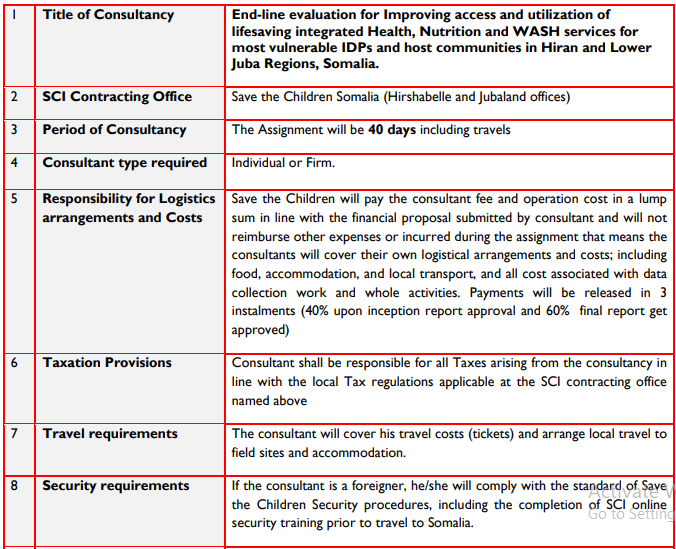
Save the Children aims to conduct an external end-line evaluation for the project titled "Improving Access and
Utilization of Lifesaving Integrated Health and Nutrition Services for the Most Vulnerable Internally Displaced
Persons (IDPs) and Host Communities in Hiiran Region, Somalia." To effectively document project outcomes
and develop recommendations for enhancing similar future implementations, we seek to employ the services of a skilled and reputable independent consultant.
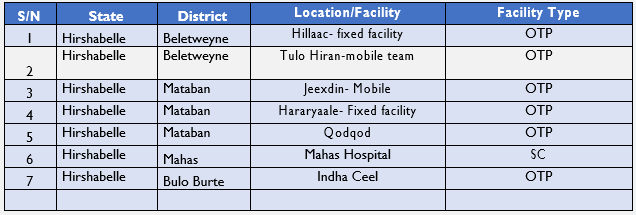
Project Locations
Save the Children continued support 7 health sites in three district (4 mobile team sites, 2 fixed OTP sites and one Stabilization Center).
GENERAL OBJECTIVE OF THE EVALUATION
The purpose of this evaluation is to assess how the project contributed to address outstanding gaps regarding access to health and nutrition service in target areas and document learnings to inform future similar programming. The project will be evaluated using OECD DAC criteria which assesses the relevance, effectiveness, efficiency, sustainability, impact, well-coordinated, and gender-sensitivity and disability inclusiveness of the project).
SPECIFIC OBJECTIVE
✓ Conducting household survey to assess the access the target people in the target communities to health and nutrition services.
✓ Conducting comprehensive desk and literature review to inform primary data collection.
✓ Conduct FGDs and KII with project key stakeholders including MtMSG/FtFSG, facilities in charge, health staff, community leaders, government officials, and SCI Staff. Triangulate qualitative information with quantitative data to ensure accuracy.
✓ Identify key intended and unintended outcomes and impact level results (both positive and negative) that this project has contributed to and assess to what extent the integration approaches have been successful in creating the intended outcomes and impact outlined in the program documentation.
✓ To provide recommendations based on the findings for future use and improvement actions.
✓ To evaluate the relevance, effectiveness, efficiency, impact, sustainability of the project.
✓ Nutrition data extraction from OTP/TSFP/SC registers, measuring key variables such as (Admissions over time, Admissions per Facility, Program discharge outcomes, MUAC at Admission, MUAC at discharge Cured, MUAC at Discharge Default, Length of stay before discharge as cured, Length of stay before discharge as default.
✓ Conducting an EPI data quality assessment involves extracting data from registers, summary sheets, and tally sheets, followed by a comprehensive analysis
✓ Produce factsheets to capture the main findings of the evaluation
METHODOLOGY
The final evaluation will utilize a mixed-method approach, combining both qualitative and quantitative data collection methods to gather both secondary and primary data/information which will allow for an examination of both the intended and unintended outcomes of the project.
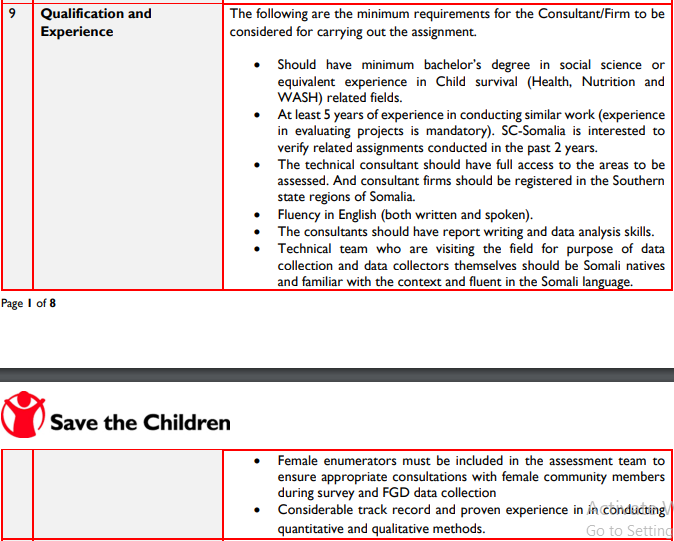
Applications can be submitted by either:
Electronic Submission via ProSave (Recommended)
• Submit your response in accordance with the guidance provided in the below document:
• Bidders are encouraged to apply via Ariba system. Please request the Ariba link via email sending your company profile and Business registration certificate/CV. Please address your Ariba link request to css.logistics@savethechildren.org
Electronic Submission via Protected Email box (Optional)
• Email should be addressed to southcentral.supplychain@savethechildren.org
• Note – this is a sealed tender box which will not be opened until the tender has closed. Therefore, do not send tender related questions to this email address as they will not be answered.
• The subject of the email should be: “End-line evaluation for Improving access and utilization of lifesaving integrated Health, Nutrition and WASH services”
• All attached documents should be clearly labelled so it is clear to understand what each file relates to.
• Emails should not exceed 15 MB – if the file sizes are large, please split the submission into two emails. Do not copy other SCI email addresses into the email when you submit it as this will invalidate your bid
Your bid must be received, no later than 15th February 2025
Bids must remain valid and open for consideration for a period of no less than 60 days
WE BELIEVE EVERY CHILD DESERVES A FUTURE. Around the world, too many children start life at a disadvantage simply because of who they are and where they come from. Millions of children are dying from preventable causes, face poverty, violence, di... Read More